Medical Office Cleaning NJ – Vilarinho Cleaning Services
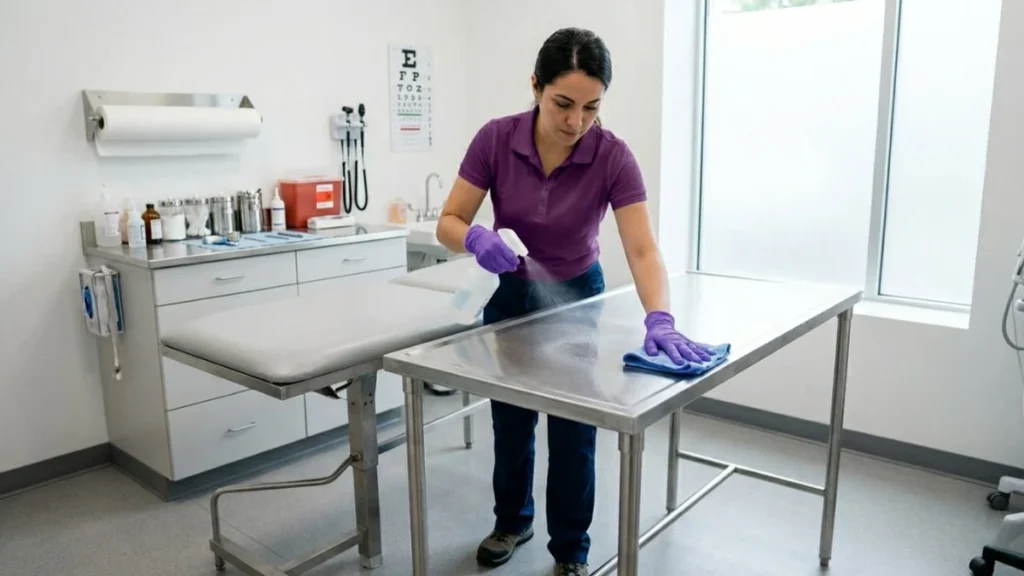
Professional medical office cleaning in NJ requires OSHA-compliant protocols and EPA-registered disinfectants. Standard janitorial service does not meet this standard. Medical office cleaning in NJ operates in a different category from standard commercial janitorial work. The federal regulations governing healthcare facility sanitation, primarily OSHA’s Bloodborne Pathogens Standard 29 CFR 1910.1030, require a written cleaning and decontamination schedule, EPA-registered hospital-grade disinfectants, proper personal protective equipment for cleaning staff, and documented protocols for handling potentially infectious materials. For any clinic, dental practice, or specialty office in Union County, choosing a cleaning provider without this training is both an operational risk and a compliance exposure. Vilarinho Cleaning Services LLC, based in Union NJ, serves medical and dental offices across the region with sanitation protocols designed to meet these standards. This guide explains what the regulations actually require, why the difference between a trained medical cleaning team and a general janitorial crew matters, and how to evaluate providers before signing a contract. Ready to schedule medical office cleaning in NJ? Vilarinho serves clinics and dental offices across Union County. Free consultation available. 📞 Call (973) 289-0890 💬 Send a Text What OSHA Actually Requires for Medical Office Cleaning The Bloodborne Pathogens Standard is the most frequently cited OSHA regulation in medical and dental offices across New Jersey. Under 29 CFR 1910.1030(d)(4)(i), the employer must determine and implement an appropriate written schedule of cleaning and decontamination based on the specific location within the facility. That language matters: a waiting room and an examination room carry different contamination risk profiles and require different cleaning sequences and products. The standard requires that cleaning staff working in areas with potential bloodborne pathogen exposure use appropriate PPE, including gloves and eye or face protection. All surfaces in clinical contact areas must be cleaned with an EPA-registered hospital-grade disinfectant capable of killing the pathogens present in that environment. Regulated waste, meaning materials soaked or saturated with blood or other potentially infectious material, must be handled, contained, and disposed of separately from general trash. New Jersey operates under OSHA’s federal framework, with the state’s Public Employees Occupational Safety and Health (PEOSH) program extending the same bloodborne pathogen standards to public healthcare workers. Private medical practices fall directly under federal OSHA enforcement. Serious violations carry fines up to $15,625 per incident; willful infractions can reach $156,259. A documented cleaning protocol from a qualified provider is one of the clearest demonstrations of compliance during an inspection. OSHA requires a written, location-specific decontamination schedule, not a one-size-fits-all janitorial routine. HIPAA and Physical Safeguards: The Part Most Cleaning Companies Overlook HIPAA’s Privacy Rule is typically associated with data security, but its Physical Safeguard requirements have direct implications for who can access clinical spaces and under what conditions. Protected health information is present throughout a medical office in forms that are easy to overlook: open intake forms at the front desk, patient records visible on a workstation screen, prescription pads on a counter, or a sign-in sheet left on the reception ledge. Cleaning staff who enter these areas, particularly during after-hours service when no clinic personnel are present, must operate under protocols that protect patient confidentiality. That means a credible medical office cleaning provider in NJ should require confidentiality agreements from all employees, establish supervised or credentialed access to sensitive zones, and train staff on what constitutes protected health information and how to handle encounters with it during routine cleaning tasks. For dental and specialty practices in Summit, Westfield, and Millburn that operate under third-party accreditation or insurance contracts with specific sanitation clauses, this documentation trail becomes part of the facility’s compliance record. A provider who cannot supply it is a liability, not an asset. Zone-Based Decontamination: How a Medical Office Is Actually Cleaned The fundamental principle in healthcare facility cleaning is containment: preventing pathogens from moving from higher-risk zones to lower-risk areas. A properly trained medical cleaning team operates with a zone hierarchy and never crosses it with the same tools or products. Clinical contact surfaces such as examination tables, dental chairs, procedure lights, and tray stands receive individual disinfection with hospital-grade products after each patient contact and a thorough end-of-day treatment. Hard floors in exam rooms are mopped with a different mop head and solution than the lobby. Restroom cleaning equipment never enters clinical areas. Waiting areas, while not clinical zones, are high-traffic shared spaces requiring frequent disinfection of seating arms, door hardware, tablet check-in devices, and any communal reading materials. This zone discipline is the technical gap that separates a trained medical office cleaning service in NJ from a general janitorial crew. The products may look identical on a supply shelf. The training and protocols are not. Floor surfaces in clinical areas require separate protocols. Tools used in exam rooms should never cross into waiting areas or administrative zones. Sanitizing vs. Disinfecting: A Distinction That Matters in Healthcare These terms are used interchangeably in everyday conversation and incorrectly in most janitorial marketing. The regulatory distinction is specific. Sanitizing reduces surface bacteria to a safe level defined by public health standards, typically a 99.9% reduction. That threshold is adequate for food service environments and general offices. Disinfecting kills or inactivates a much broader spectrum of pathogens, including viruses, fungi, and drug-resistant bacteria such as MRSA, at the higher efficacy levels required in healthcare settings. The CDC’s guidance on healthcare environmental cleaning specifies disinfection as the standard for patient care surfaces, not sanitization. EPA-registered hospital disinfectants carry label claims against specific organisms and are tested to meet those claims. For a dental practice in Union or a physical therapy clinic in Clark, using a sanitizing product instead of a disinfecting agent on a treatment surface is a technical OSHA violation, regardless of how clean the space looks afterward. The distinction is chemical, not cosmetic. Medical Office Cleaning Across Union County NJ Union County holds a dense concentration of small and mid-size medical practices: primary care offices, pediatric clinics, physical therapy centers, urgent care facilities, and dental groups ranging from solo practitioners to multi-chair group